Understanding the benefits, limitations, industry practices and supply-chain implications of stainless steel passivation.
Stainless steel fasteners are widely used in construction, manufacturing, marine equipment and industrial applications because of their corrosion resistance and durability.
But when purchasing stainless steel bolts, screws or nuts, a question frequently arises:
Do stainless steel fasteners need chemical passivation, or is their natural corrosion resistance already sufficient?
Some customers specifically require passivation, while others purchase standard A2 or A4 stainless steel fasteners without mentioning surface treatment.
For procurement professionals, the distinction can affect pricing, supplier selection, lead times and compliance documentation.
For engineers, it raises a more fundamental question: does chemical passivation meaningfully improve performance in the intended application?
The answer depends on the material, manufacturing process, operating environment and contractual requirements.
1. What Is Stainless Steel Passivation?
Stainless steel contains chromium, which reacts with oxygen to form an extremely thin, protective chromium-rich oxide film on its surface.
This passive layer provides much of stainless steel's corrosion resistance.
Unlike zinc plating or paint, the protective film is naturally formed by the material itself. When damaged, it can reform if the surface is sufficiently clean and environmental conditions are suitable.
This process is known as natural passivation.
Natural vs Chemical Passivation
Chemical passivation is an additional manufacturing treatment designed to improve surface cleanliness and promote a stable passive condition.
During fastener production, contamination may be introduced through:
- Cold heading and thread rolling
- CNC machining and drilling
- Contact with carbon-steel tooling
- Grinding and polishing
- Manufacturing equipment, handling and storage
These operations can leave free iron particles or other contaminants on stainless steel surfaces.
When exposed to moisture, embedded or deposited iron particles may rust, creating surface staining and potential sites for localised corrosion.
Chemical passivation removes certain surface contaminants, especially free iron, helping the stainless steel develop a more consistent protective surface.
The important distinction is that chemical passivation improves the surface condition of stainless steel; it does not change the underlying material grade.
Common Passivation Methods
Two widely used chemical approaches are:
Nitric acid passivation: A traditional and well-established method for removing free iron contamination and promoting a clean passive surface.
Citric acid passivation: An alternative using citric acid solutions. It can offer advantages in chemical handling and environmental management compared with nitric acid processes.
Citric acid treatment has gained industry interest for these reasons, although treatment suitability depends on the stainless steel grade, process controls and required verification.
ASTM A967/A967M-25 covers nitric acid, citric acid and electrochemical passivation treatments.
2. Passivated vs Non-Passivated Stainless Steel Fasteners
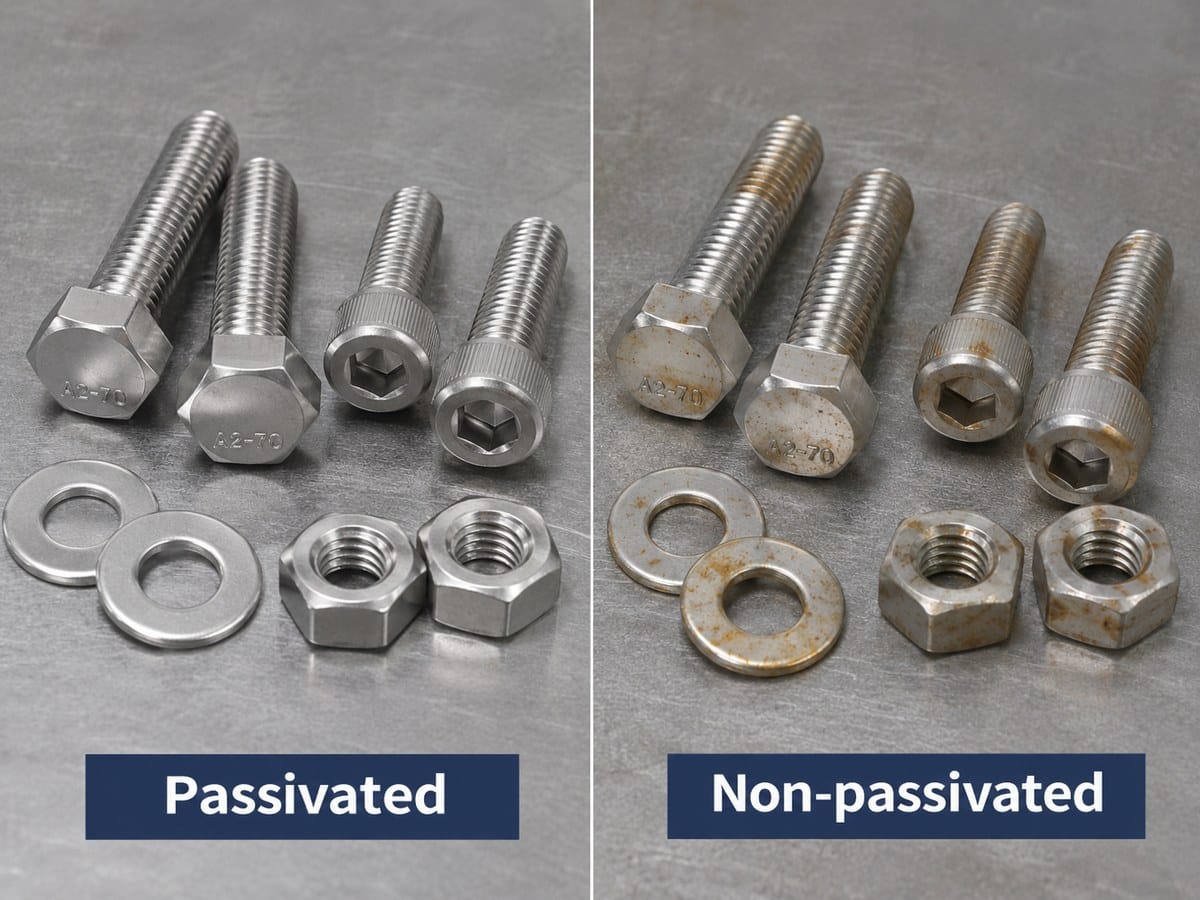
Passivated versus non-passivated A2-70 stainless fasteners after exposure \u2014 free iron contamination on the untreated parts shows as rust staining.
A common misconception is that stainless steel fasteners without chemical passivation have no corrosion protection.
This is incorrect.
Clean, properly manufactured stainless steel already develops a naturally protective oxide film.
The main difference between chemically passivated and non-chemically-passivated fasteners is the condition of the finished surface.
| Property | Chemically passivated | Not chemically passivated |
|---|---|---|
| Stainless steel grade | Unchanged | Unchanged |
| Natural protective film | Present | Present under suitable conditions |
| Free iron contamination | Reduced by treatment | Depends on manufacturing cleanliness |
| Corrosion performance | More consistent surface condition | Can be excellent if clean |
| Mechanical strength | Unchanged | Unchanged |
| Dimensions | Normally unchanged | Unchanged |
| Processing cost | Additional treatment | Generally lower |
| Lead time | May require extra processing | Usually shorter |
| Documentation | Treatment evidence may be required | Standard product documents |
For example, an A4-80 stainless steel screw does not become stronger after passivation.
Its specified mechanical property class remains the same.
Similarly, chemical passivation does not transform A2 stainless steel into A4 stainless steel. The corrosion resistance associated with the base alloy remains a separate consideration.
3. Benefits of Chemical Passivation
3.1 Reduced Risk of Surface Rust Staining
One of the most important benefits is the removal of free iron contamination.
Even high-quality stainless steel can develop visible rust staining when carbon-steel particles contaminate its surface.
Chemical passivation helps minimise this risk.
3.2 More Consistent Corrosion Resistance
Passivation can provide additional assurance that the finished component has a clean surface suitable for forming its protective oxide film.
This is particularly useful when fasteners undergo multiple manufacturing operations, including machining, forming and secondary processing.
3.3 Better Process Control and Verification
When passivation is carried out to a recognised specification, the process may include documented treatment conditions and verification testing.
This offers additional confidence for applications with stringent quality requirements.
3.4 Additional Protection in Corrosion-Sensitive Applications
Passivation is worth considering for fasteners used in marine equipment, chemical processing, medical equipment, food processing and other environments where surface contamination could compromise performance.
However, passivation should be considered part of an overall corrosion-control strategy rather than a substitute for selecting a suitable stainless steel grade.
4. Limitations and Disadvantages
Chemical passivation provides benefits, but it also introduces additional considerations.
4.1 Additional Cost
Passivation requires preparation, chemical treatment, rinsing, handling and potentially additional inspection.
When incorporated into large-volume production, the additional cost per fastener may be relatively low.
For small batches of specially manufactured fasteners, minimum processing charges can make the treatment disproportionately expensive.
4.2 Longer Lead Times
Not every fastener manufacturer has in-house passivation facilities.
If treatment must be outsourced, additional time may be required for transport, subcontractor scheduling, processing, inspection and documentation.
A simple surface-treatment requirement can therefore become a significant procurement constraint.
4.3 Limited Additional Benefit in Some Applications
For standard stainless steel fasteners used in clean, relatively dry indoor environments, chemical passivation may provide little practical benefit if manufacturing cleanliness is already well controlled.
In these cases, the additional processing may not be justified by the expected service conditions.
4.4 Passivation Cannot Fix Every Corrosion Problem
Chemical passivation is not a universal corrosion treatment.
It does not reliably remove heavy oxide scale or welding heat tint. These conditions may require pickling, mechanical preparation or other appropriate cleaning methods before passivation.
It also cannot compensate for poor material selection.
For example, A4 stainless steel can still suffer pitting or crevice corrosion in aggressive chloride environments.
Passivation should not be viewed as a replacement for selecting an appropriate stainless steel grade.
5. What Is Normal Practice in the Fastener Industry?
This is one of the most important considerations for buyers and engineers.
Not every stainless steel fastener is chemically passivated, and chemical passivation is not automatically mandatory under ISO 3506.
5.1 ISO 3506 Requirements
ISO 3506-1:2020 covers the mechanical properties of corrosion-resistant stainless steel bolts, screws and studs.
Clause 6.3 addresses surface finish.
The standard provides for fasteners to be supplied in a clean and bright condition unless otherwise specified and recommends passivation for maximum corrosion resistance.
It also references ISO 16048 for stainless steel fastener passivation.
This means a standard A2-70 or A4-80 fastener may comply with ISO 3506-1 without having undergone additional chemical passivation.
However, compliance with ISO 3506 alone does not demonstrate that chemical passivation has been performed.
5.2 Standard Commercial Fasteners
For commonly stocked stainless steel fasteners manufactured to standards such as ISO 4014, ISO 4017, ISO 4762 and DIN 933, passivation practices vary between manufacturers.
Some manufacturers incorporate chemical passivation into their production process.
Others supply products after appropriate cleaning, relying on the natural corrosion resistance of stainless steel.
Neither situation should be assumed simply from the product description.
A catalogue listing such as:
M10 × 50 Hex Bolt, A4-70, ISO 4017
does not, by itself, confirm whether chemical passivation has been performed.
The actual finishing process must be verified with the supplier.
5.3 What Does the “P” Designation Mean?
ISO 3506-1:2020 permits fasteners passivated in accordance with ISO 16048 to be additionally identified with the letter P after the property class designation on the label.
However, this designation is not universally used.
The absence of a P designation does not prove that a fastener has not been passivated.
Equally, the presence of an undocumented marking should not replace verification of the applicable treatment specification.
For controlled procurement, supplier documentation remains more reliable than assumptions based on markings or appearance.
5.4 Special-Manufacture and High-Specification Fasteners
Custom fasteners may have additional requirements beyond standard dimensions and mechanical properties.
These can include:
- Special material grades or mechanical properties
- Identification and traceability markings
- EN 10204 Type 3.1 inspection certificates
- Surface treatment requirements
- Project-specific testing and documentation
For defence, marine, aerospace and other controlled applications, chemical passivation may be explicitly specified.
In such cases, omitting the treatment is a technical deviation, even when the fastener otherwise complies with the material and dimensional requirements.
The drawing, purchase order and applicable project specifications take precedence.
6. Relevant Standards for Stainless Steel Passivation
Several standards are commonly encountered.
| Standard | Scope |
|---|---|
| ISO 3506-1:2020 | Mechanical properties and general requirements for stainless steel bolts, screws and studs |
| ISO 16048:2003 | Passivation of corrosion-resistant stainless steel fasteners |
| ASTM A967/A967M-25 | Chemical passivation treatments and verification methods for stainless steel parts |
| ASTM A380/A380M | Cleaning, descaling and passivation practices |
| EN 10204 | Types of inspection documents for metallic products |
ISO 16048 vs ASTM A967
ISO 16048 is specifically intended for corrosion-resistant stainless steel fasteners.
ASTM A967 has a broader scope, covering chemical passivation treatments for stainless steel parts generally.
ASTM A967 also addresses alternative verification methods, including tests intended to assess removal of surface contamination.
For engineering procurement, the passivation requirement should identify the relevant standard and, where necessary, the treatment method and acceptance criteria.
Simply stating "stainless steel, passivated" may leave too much room for interpretation.
Does EN 10204 Type 3.1 Certification Prove Passivation?
Not automatically.
An EN 10204 Type 3.1 inspection certificate provides a declaration of compliance with the order and relevant specific inspection results.
However, a material or mechanical-property certificate does not inherently prove that a particular chemical passivation process was completed.
When passivation is mandatory, the purchaser should establish whether a separate treatment certificate or other objective evidence is required.
7. Supply-Chain Considerations: A Practical Example
Consider a customer requesting the following special-manufacture fastener:
| Requirement | Specification |
|---|---|
| Product | Flat countersunk slotted machine screw |
| Size | M6 × 25 mm |
| Standard | DIN 963 |
| Material | A4 / 316 stainless steel |
| Property class | 80 |
| Quantity | 100 pieces |
| Identification | Special head marking |
| Certification | EN 10204 Type 3.1 |
| Surface treatment | Passivated |
A manufacturer may have no difficulty producing the fasteners to the required dimensions, material grade and mechanical properties.
However, the manufacturer may not have in-house passivation facilities.
For a batch of only 100 pieces, finding an external treatment provider willing to process the order economically may prove difficult.
The supplier therefore offers the product without passivation.
From a technical perspective, the screws may still have excellent natural corrosion resistance.
From a contractual perspective, however, the quotation does not meet the original specification.
This illustrates why passivation is not only a technical decision, but also a supply-chain decision.
7.1 Supplier Qualification
Before placing an order, establish whether passivation is performed in-house or subcontracted.
Confirm the supplier's capability to process the specified material and provide the required verification and documentation.
7.2 Minimum Treatment Charges
For standard catalogue fasteners, adding a passivation requirement may force the product out of the normal stock supply channel.
Additional treatment, handling and minimum batch charges can significantly increase the delivered unit cost.
7.3 Lead-Time Risk
Outsourced passivation introduces another production stage and another supplier dependency.
When lead time is critical, confirm whether treatment capacity is available before committing to a delivery date.
7.4 Batch Traceability
Where passivation is subcontracted, maintaining manufacturing lot identification throughout treatment is essential.
Parts from different manufacturing batches should not be mixed without an approved traceability process.
This is particularly important for project-controlled orders requiring inspection documentation.
7.5 Supply Alternatives
When passivation becomes a sourcing constraint, procurement may consider:
- Finding a manufacturer with in-house passivation capability
- Selecting an approved external treatment provider
- Consolidating quantities to reduce processing costs
- Arranging local treatment after importation, subject to approval
- Seeking an authorised customer concession where treatment is not essential
Any deviation from a mandatory requirement must be agreed through the applicable customer approval process.
8. Decision Guide: When Should Passivation Be Specified?
The most practical approach is to evaluate the application rather than apply the same treatment requirement to every stainless steel fastener.
| Application | Recommended consideration |
|---|---|
| General indoor industrial use | Often unnecessary with clean, controlled manufacturing |
| Standard catalogue fasteners | Verify existing finish before requesting additional treatment |
| Outdoor industrial equipment | Assess exposure, contamination and maintenance |
| Marine and offshore | Strongly consider, but verify alloy suitability first |
| Food and pharmaceutical equipment | Evaluate hygiene, cleaning and surface requirements |
| High-purity or precision equipment | Consider where surface contamination is critical |
| Defence and aerospace | Follow the governing drawing and specifications |
| Explicit customer passivation requirement | Mandatory unless an authorised deviation is approved |
A Simple Three-Question Decision Framework
Before adding passivation to a purchase specification, ask:
1. Is it required by the engineering drawing or customer specification?
If yes, it must be supplied as specified unless a formal deviation is approved.
2. Does the application justify additional surface treatment?
Consider moisture, chlorides, chemicals, hygiene requirements and the consequences of corrosion.
3. Can the manufacturing process deliver an adequately clean surface without additional treatment?
A supplier with controlled tooling, cleaning and handling may be able to provide satisfactory corrosion performance in less demanding applications.
If additional passivation is justified, specify the process, verification and documentation requirements clearly.
9. Questions Every Fastener Buyer Should Ask
A well-defined RFQ can prevent unnecessary cost and confusion.
One particularly useful question is:
“Is this lot chemically passivated to ISO 16048 or ASTM A967, or is it supplied in the normal clean and bright condition?”
Additional questions include:
- Is passivation performed in-house or by an external subcontractor?
- Which treatment specification and method will be used?
- What verification testing is included?
- Will a separate passivation certificate be provided?
- Is the manufacturing lot fully traceable after treatment?
- What additional cost and lead time apply?
- If passivation cannot be supplied, can an alternative be formally submitted for approval?
These questions help distinguish a genuinely controlled surface-treatment process from a general statement that the fastener is corrosion-resistant.
10. Frequently Asked Questions
Are all A2 and A4 stainless steel fasteners passivated?
No. A2 and A4 identify stainless steel grades, not whether chemical passivation has been performed. Some manufacturers chemically passivate their products; others supply them in the normal clean and bright condition.
Does passivation make A4-80 stainless steel stronger?
No. Passivation is a surface treatment and does not increase the specified mechanical strength of an A4-80 fastener.
Can stainless steel rust without passivation?
Yes. Stainless steel can experience corrosion or rust staining under certain conditions, particularly where surface contamination, chlorides or crevices are present. Chemical passivation can reduce risks associated with free iron contamination but cannot eliminate every corrosion mechanism.
Is passivation mandatory for marine stainless steel fasteners?
Not universally. It may be required by the project specification and can be beneficial, but selecting a suitable stainless steel grade and designing for the service environment are generally more fundamental to long-term corrosion performance.
11. Conclusion: Specify Passivation Where It Adds Value
Chemical passivation is a useful process for improving the surface cleanliness and consistency of stainless steel fasteners, especially where manufacturing contamination or corrosion risk is a concern.
However, it is not a universal requirement.
For many standard A2 and A4 stainless steel products manufactured under controlled conditions, the naturally formed passive film can provide adequate corrosion resistance without additional chemical treatment.
For demanding applications, passivation may provide valuable additional assurance, but it cannot compensate for an unsuitable material grade or poor component design.
From a supply-chain perspective, specifying passivation unnecessarily can increase costs, restrict supplier availability and extend lead times, particularly for standard catalogue products and small-batch special manufacturing.
The best approach is to specify passivation when the application, manufacturing risk or customer requirements justify it—and confirm the treatment and supporting documentation with the supplier rather than assuming it is included.
References and Further Reading
- ISO 3506-1:2020 — Mechanical properties of corrosion-resistant stainless steel fasteners — Part 1: Bolts, screws and studs.
- ISO 16048:2003 — Passivation of corrosion-resistant stainless-steel fasteners.
- ASTM A967/A967M-25 — Standard Specification for Chemical Passivation Treatments for Stainless Steel Parts.
- ASTM A380/A380M — Standard Practice for Cleaning, Descaling, and Passivation of Stainless Steel Parts, Equipment, and Systems.
- EN 10204 — Metallic products — Types of inspection documents.
Technical note: This article provides general engineering and procurement guidance. Always refer to the applicable drawing, purchase specification and current technical standards when determining passivation requirements.